
One record that remembers everything you did for this customer
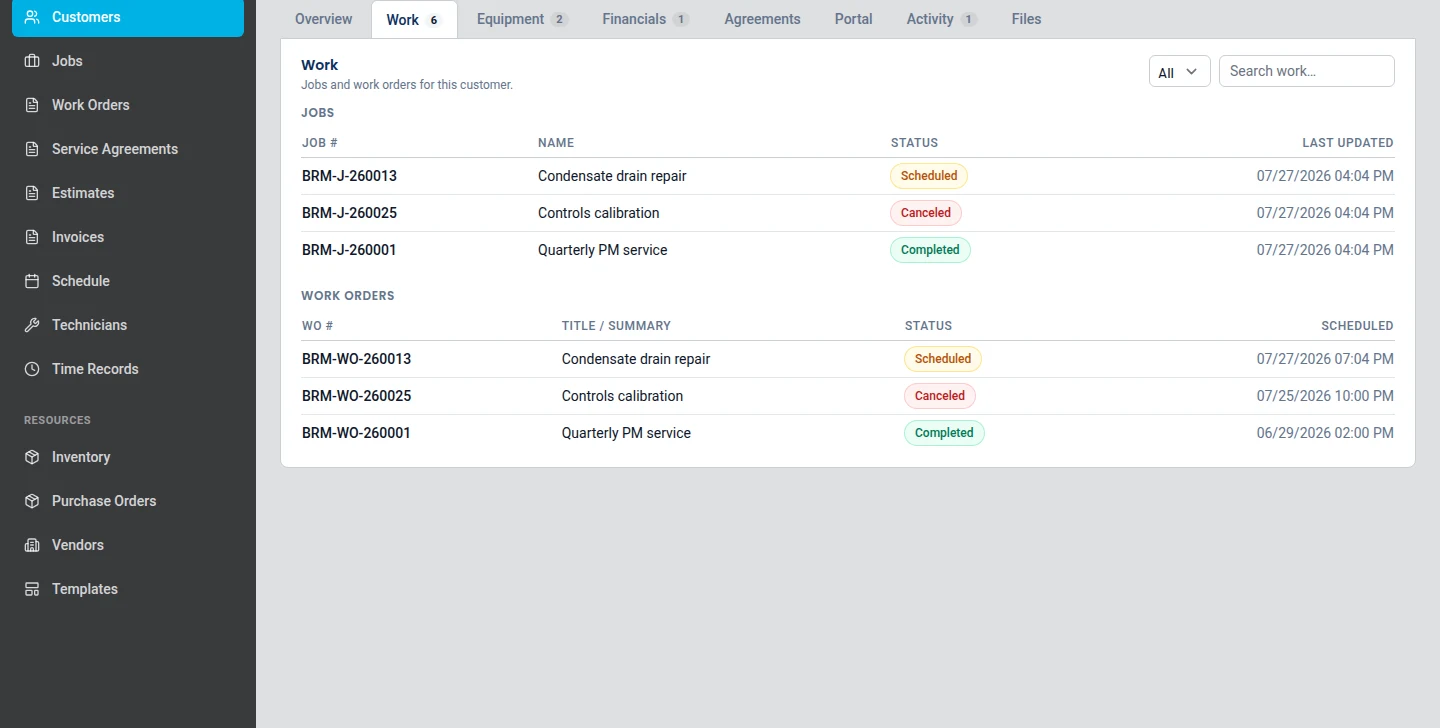
Sites, jobs, work orders, estimates, and invoices on a single customer record — so the answer to “what did we do last time?” takes seconds, not a search through email.
Why this is worth solving
In field service the customer is not a lead in a sales pipeline — it is a place with equipment, a history of what broke, and a person who expects you to remember. General-purpose CRM tools model the first of those and none of the rest.
The practical failure is small and constant: someone calls about a job from eight months ago, and the person answering has no way to see it without asking three colleagues.
What it looks like
What you get
Service addresses separate from billing
A customer can hold multiple service addresses, so a property manager with nine buildings is one account with nine sites — not nine disconnected customers who happen to share a name.
Work history in one place, in order
Jobs and work orders for a customer sit on that customer's record in date order. What was done, when, and by whom is retrievable while the customer is still on the phone.
Money history alongside work history
Estimates and invoices for the account live on the same record as the work, so an “I already paid that” conversation has evidence behind it.
Equipment stays attached to the site
Units installed at a customer site are recorded against that site with make, model, and serial, so the history follows the equipment rather than the technician who happened to service it.
Straight answers
Is this a sales CRM with pipelines and forecasting?
No. ServusOne's customer record is built around service history — sites, jobs, equipment, estimates, and invoices. It is not a sales-pipeline or forecasting tool.
Put it against a real week of work
The 14-day trial starts without a card, and the plans are published in full if you would rather look at those first.