
Know what is installed before you send anyone to look at it
Customer equipment recorded by make, model, and serial, with service logs and planned services attached — so history follows the unit, not the technician who remembers it.
Why this is worth solving
When the same rooftop unit has been repaired four times by three different technicians, the useful question is not “what is wrong with it” but “what have we already tried.” Without a record attached to the unit, that knowledge lives in whoever happens to be on shift.
The second failure is parts. Arriving without knowing the model number is an automatic second visit.
What it looks like
What you get
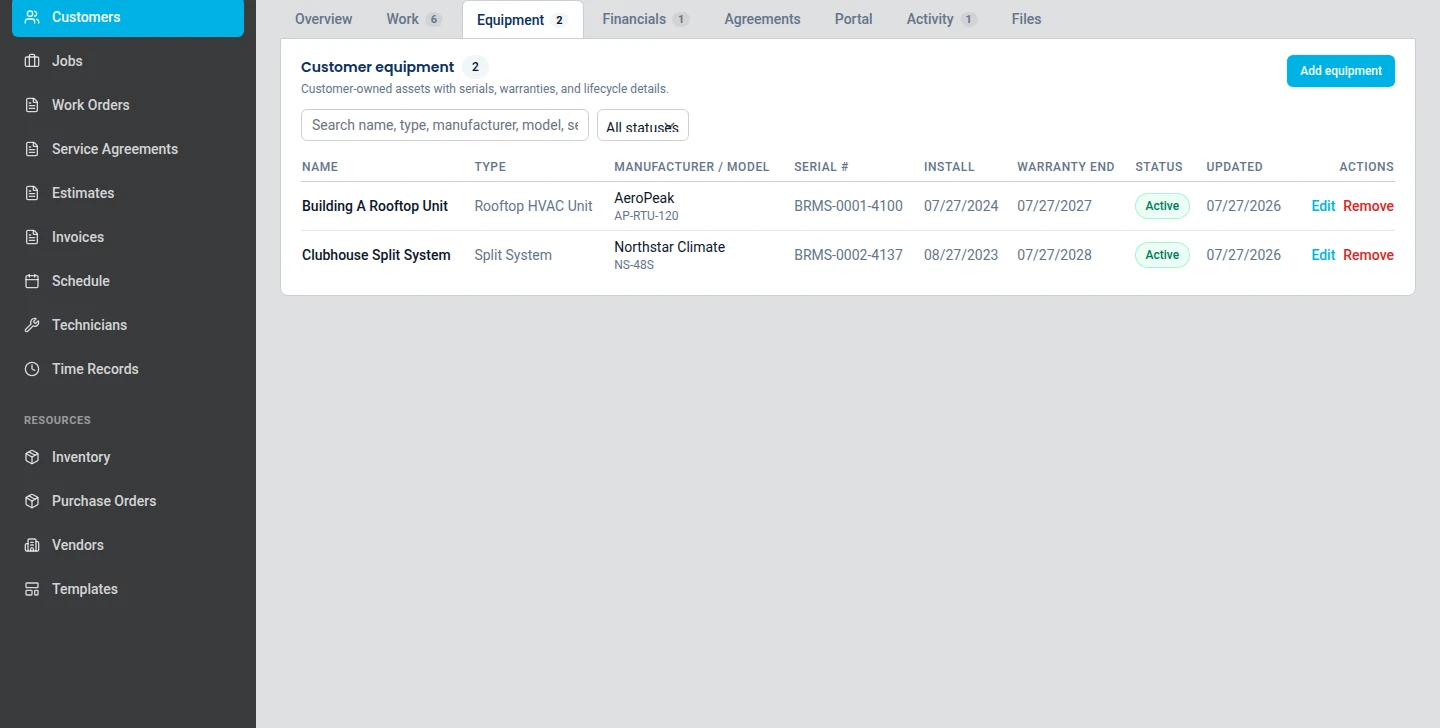
Equipment recorded against the site
Units are captured on the customer record with the identifying detail that actually matters in the field — make, model, and serial — so a technician can order the right part before driving out.
Service logs attached to the unit
Service entries are recorded against the asset itself, so the unit's history is readable as a sequence rather than reconstructed from unrelated work orders.
Planned service on a schedule
Asset service plans record what recurring service a unit is due, and due services can be processed into upcoming work rather than depending on someone's reminder.
Not vehicle tracking — and named accordingly
This is a record of the customer equipment you service. The route was renamed away from “fleet tracking” precisely because that address implied a live vehicle capability ServusOne does not have.
Straight answers
Does this feature provide fleet management or live vehicle tracking?
No. Fleet management, GPS, live location, telematics, and movement alerts are not current public ServusOne capabilities.
Does ServusOne integrate with vehicle telematics providers?
No. Vehicle integrations are not currently offered as public ServusOne capabilities.
Put it against a real week of work
The 14-day trial starts without a card, and the plans are published in full if you would rather look at those first.