
Built around what happened at that address last time
Quoting, scheduling and invoicing are table stakes; both products do them. ServusOne is the one whose spine is the customer's equipment and its service record — which is what a returning technician actually needs.
What ServusOne is
If your work is returning to the same customers and the same installed units, the question is not which product has more features. It is which one remembers. ServusOne puts sites, equipment, past visits, estimates and invoices on one customer record, so the person attending today starts from what the last one found.
The commercial shape is straightforward too: published plans, published included seats, a published per-additional-user rate, and a fourteen-day trial with no card. You can price your office and your field team together, and test the thing that matters on your own jobs.
ServusOne is the right call when
Where ServusOne stands out
Service history is the spine, not a tab. A customer's past jobs, work orders and visits are the record, and each installed unit on their site carries its own service history with make, model and serial number. For a business built on returning to the same equipment, that shape matters more than the length of a feature list.
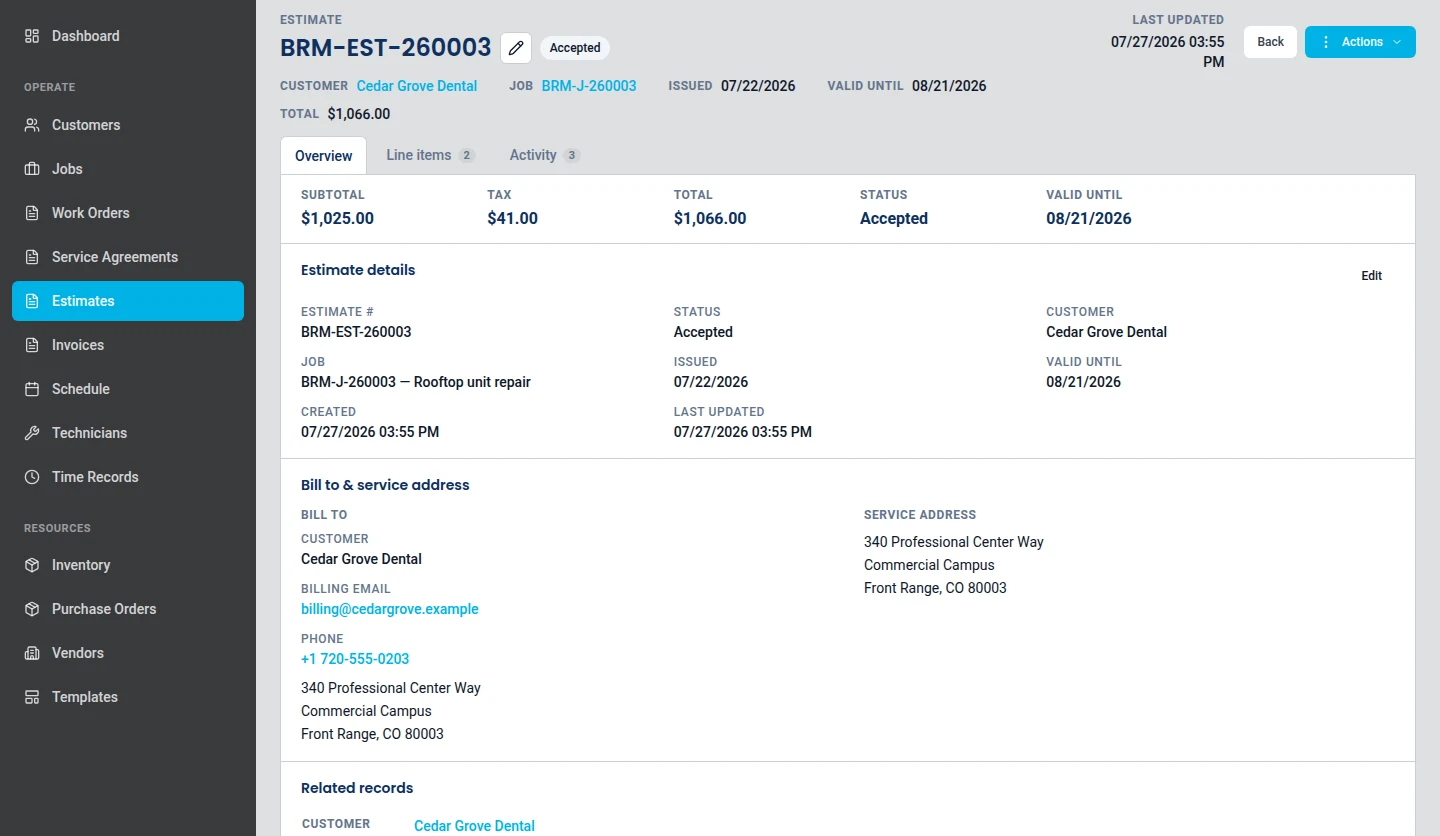
Estimate and invoice are one continuous thread. An accepted estimate carries its line items and totals into the invoice, and payments recorded against that invoice stay attached to the job they came from. There is no re-keying step where the numbers can quietly diverge.
A customer portal without a second product. Customers see their own work orders, invoices and accepted estimates in one place, as part of the same system rather than as something else to buy and connect.
The accounting handoff is a connection, not a chore. ServusOne connects to QuickBooks Online. Customers and invoices carry across, payments reconcile back when you enable them, and a matched customer is linked on an exact email rather than guessed at.
The part of ServusOne this comes down to
What changes in a week of work
Ask what the second visit looks like
The clearest way to separate these two is to walk a repeat call on the same equipment through both trials. What does each system show the technician on arrival? If that answer matters to your work, it is the whole comparison.
Count every seat, not every technician
Office staff, dispatchers and owners need logins too. ServusOne publishes its included seats and its per-additional-user rate, so you can cost your real headcount rather than your crew size.
Check the mobile question early
If your technicians need the job on a phone, find out which plan of each product provides that before comparing anything else. It moves the cost comparison more than any single feature does.
Follow one job all the way to the bank
Quote, schedule, work order, materials, hours, invoice, payment, accounting record. Run one job end to end in a trial and watch where it needs a human to retype something. That is your real running cost.
Where Jobber fits better
Jobber is an established product with a large user base, and there are businesses it suits better. This is the short, factual version, read from its own pricing page on the date shown.
What Jobber publishes
- Jobber publishes four plans — Core, Connect, Grow and Plus.
- Those plans include one, five, ten and fifteen users respectively.
- Additional users beyond a plan's included seats are charged per user per month.
- It offers a 14-day free trial on its Grow plan with no credit card required.
- It offers monthly, one-year-commitment and annual prepaid billing.
Choose Jobber when
- You are a single operator or a very small crew and want the smallest sensible starting plan.
- The larger community and wider third-party app ecosystem matter to you.
- Your work is mostly one-off jobs, where deep equipment and service history is not what you are buying.
What ServusOne does not do
- A much smaller ecosystem. Jobber is established and has a long-standing app ecosystem and a deep body of third-party help around it. ServusOne is newer and none of that exists yet. Being on a well-trodden path is worth something real.
- Mobile workforce access is an Enterprise capability. It is included on the Enterprise plan and is not in the Starter or Professional public catalog. Jobber's plans are seat-based throughout.
- No GPS and no automatic route optimization. ServusOne does not offer GPS tracking, technician location or telematics, and does not compute optimized routes. Days are sequenced by hand.
Jobber statements above were read from its own published material on 2026-08-29, not from a third-party review or comparison site:
See it for yourself
Line-itemed quotes that track through to acceptance.
Customer managementSites, jobs, equipment, and invoices on one customer record.
Client portalCustomers check their own jobs, invoices, and payments.
Field service software buying guideHow to evaluate a field service system without being sold to — including this one.
Estimate-to-invoice workflow guideWhere money leaks between the accepted estimate and the paid invoice — and how to close it.
Put your own week of work through it
The trial runs for fourteen days without a card, and every plan price, included seat count and per-additional-user rate is published.