
The gap between an accepted estimate and a paid invoice
Nobody loses money on the estimate or on the invoice. They lose it in the handoff between the two, in five specific places.
The short answer
If your invoiced revenue is consistently lower than the work you performed, the cause is almost never the invoice. It is one of five handoff points: the accepted estimate not carrying its own line items forward, extra work performed but never captured, materials fitted but never recorded against the job, labour recorded loosely or late, and an invoice raised so long after the visit that nobody can defend it.
Each of those is fixable independently, and each is worth doing on its own. Work through them in that order — the earliest leak in the chain distorts everything downstream of it.
Leak one: the estimate that has to be retyped
When an accepted estimate does not carry its line items into the invoice, somebody retypes them. Retyping is where the discount that was verbally agreed becomes the discount that was applied twice, and where a line quietly disappears.
The fix is structural rather than procedural: the accepted estimate should be the thing that becomes the invoice, with its line items and totals intact. If your system requires a person to move numbers between two documents, the person is the control, and people are not reliable controls on a busy Friday.
The test
Accept an estimate, raise its invoice, and count how many values a human had to type. The correct number is close to zero.
Leak two: extra work nobody captured
Technicians routinely do more than the estimate covered — a failed part found while on site, an extra hour on a job that fought back. If the only record of that is a verbal mention to a dispatcher, it will not be billed.
The problem is rarely dishonesty and almost never laziness; it is that capturing extra work has to be possible from where the technician is standing. If additional work can only be recorded back at the office, it gets recorded when the technician remembers, which is a category of event that reliably fails on the busiest days.
Leak three: materials fitted but never recorded
Parts are the most commonly lost revenue in field service because they are physically real and administratively invisible. A part comes off the van, goes into a customer's equipment, and unless it is recorded against that specific work order it is simply gone from the numbers — counted as stock shrinkage rather than as an unbilled item.
Recording parts and materials against the work order itself, at the time, is what makes the invoice defensible and the job costing true. It also turns the same data into the answer to a different question: which jobs are actually profitable once the van stock is accounted for.
Where to look first
Compare parts consumed against parts billed for one month. The gap between those two numbers is usually the single largest recoverable amount in the whole workflow.
Leak four: labour recorded from memory
Time recorded at the end of the week is time recorded from memory, and memory rounds down. It also loses the distinction between billable job time and non-billable admin or travel, which is the distinction the job costing depends on.
Time recorded against the job while the technician is on it is the only version that is reliably accurate. Recording it with its category and its approval status attached is what lets you defend the number later without re-litigating the week.
Leak five: the invoice raised too late
An invoice raised three weeks after the visit is an invoice the customer will query, because by then nobody on either side remembers the detail. Queried invoices are paid late, discounted, or both.
Speed here is mostly a function of the four leaks above. When the estimate carried itself forward, the extra work was captured on site, the parts were recorded against the work order and the time was logged as it happened, the invoice is already substantially written and can go out the same week. When any of those failed, somebody has to reconstruct the job first, and reconstruction is what takes three weeks.
How to tell whether you have fixed it
Each of the five leaks has a number attached to it, and none of the numbers requires new software to start measuring. Track the days between the last visit on a job and the invoice going out. Track the proportion of invoices a customer queries. Compare parts consumed against parts billed for a month. Compare quoted value against invoiced value across a batch of completed jobs.
Take those four readings before you change anything, because the version of them you remember will be kinder than the version in the data. Then take them again a quarter later. The gap between quoted and invoiced value usually moves first, because capturing extra work on site is the cheapest of the five fixes to put in place.
One number, if you only track one
Median days from last visit to invoice sent. It is easy to measure, it is hard to argue with, and it moves when any of the five leaks is closed.
What good looks like
One continuous record: an estimate that is accepted and carries its line items into the invoice, a work order that collects the parts and the notes and the photographs as the job is done, time recorded against that job with its category, and an invoice raised from all of it rather than assembled from recollection.
That is a workflow claim rather than a software claim, and it is worth stating that way. Any product that keeps those four things attached to one job will close these leaks. The question to ask a vendor is not whether they have estimates and invoices — everybody does — but how many times a human retypes something between the two.
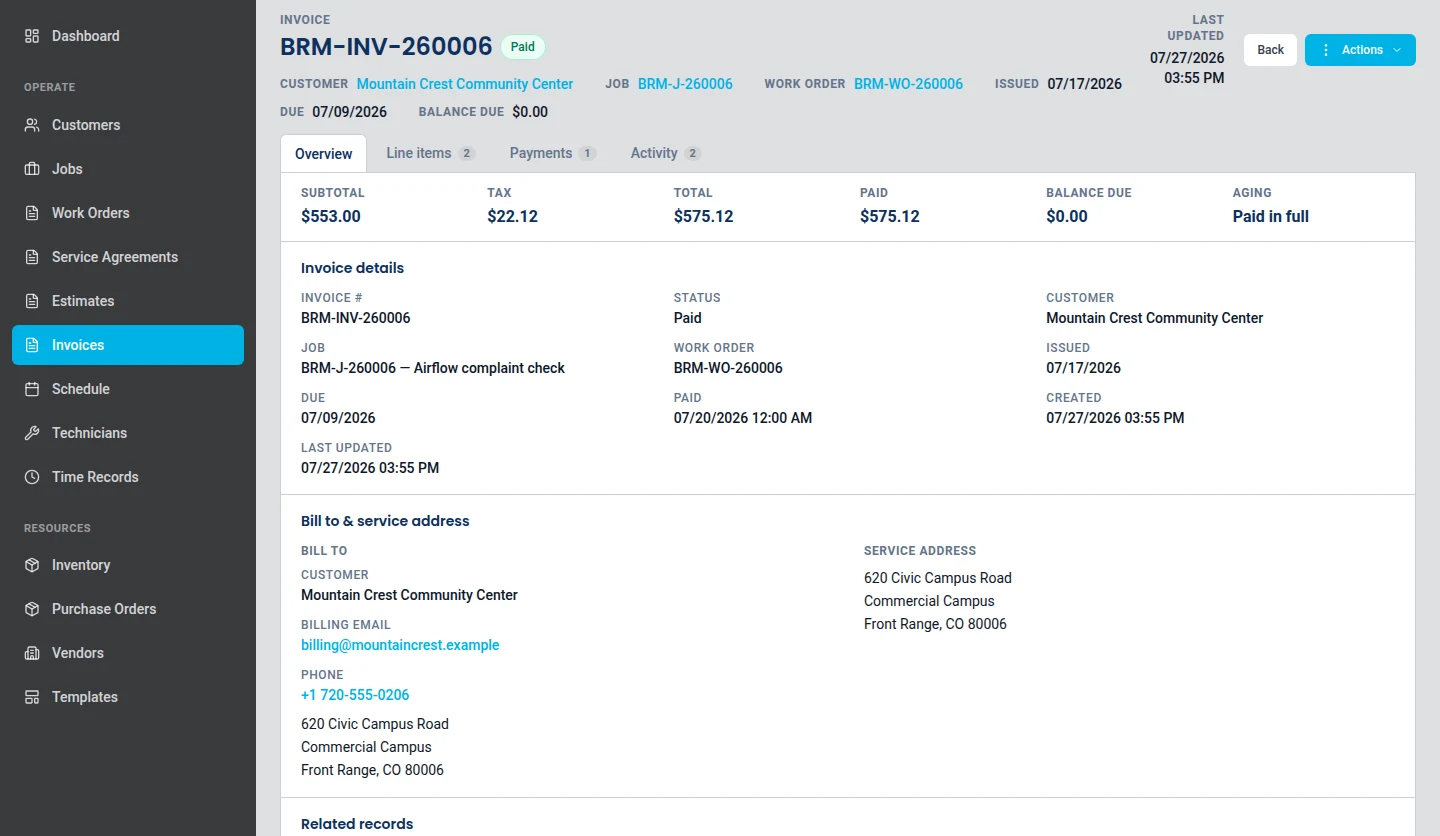
What this looks like in ServusOne
Where to go next
Line-itemed quotes that track through to acceptance.
Invoicing and paymentsInvoice completed work and see what is still outstanding.
Inventory and job costingStock, purchase orders, and the parts each job consumed.
ElectricalSame-day service calls and multi-week projects, with panel detail on every site.
PlumbingFast dispatch for emergencies, with the fittings used recorded on the job.
ServusOne vs JobberFor teams comparing seat-based plans and deciding how much history they need.
ServusOne vs Housecall ProFor teams weighing consumer-facing booking against operational depth.
Ready to try it against your own week?
The trial runs for fourteen days and does not ask for a card, so you can put a real week of work through it before deciding anything.