
Built to run the work, not just to win it
The parts fitted, the hours clocked, the unit that was serviced and the invoice that reflects all three — that is the part of the job nobody photographs, and it is where the margin is. ServusOne is built around it.
What ServusOne is
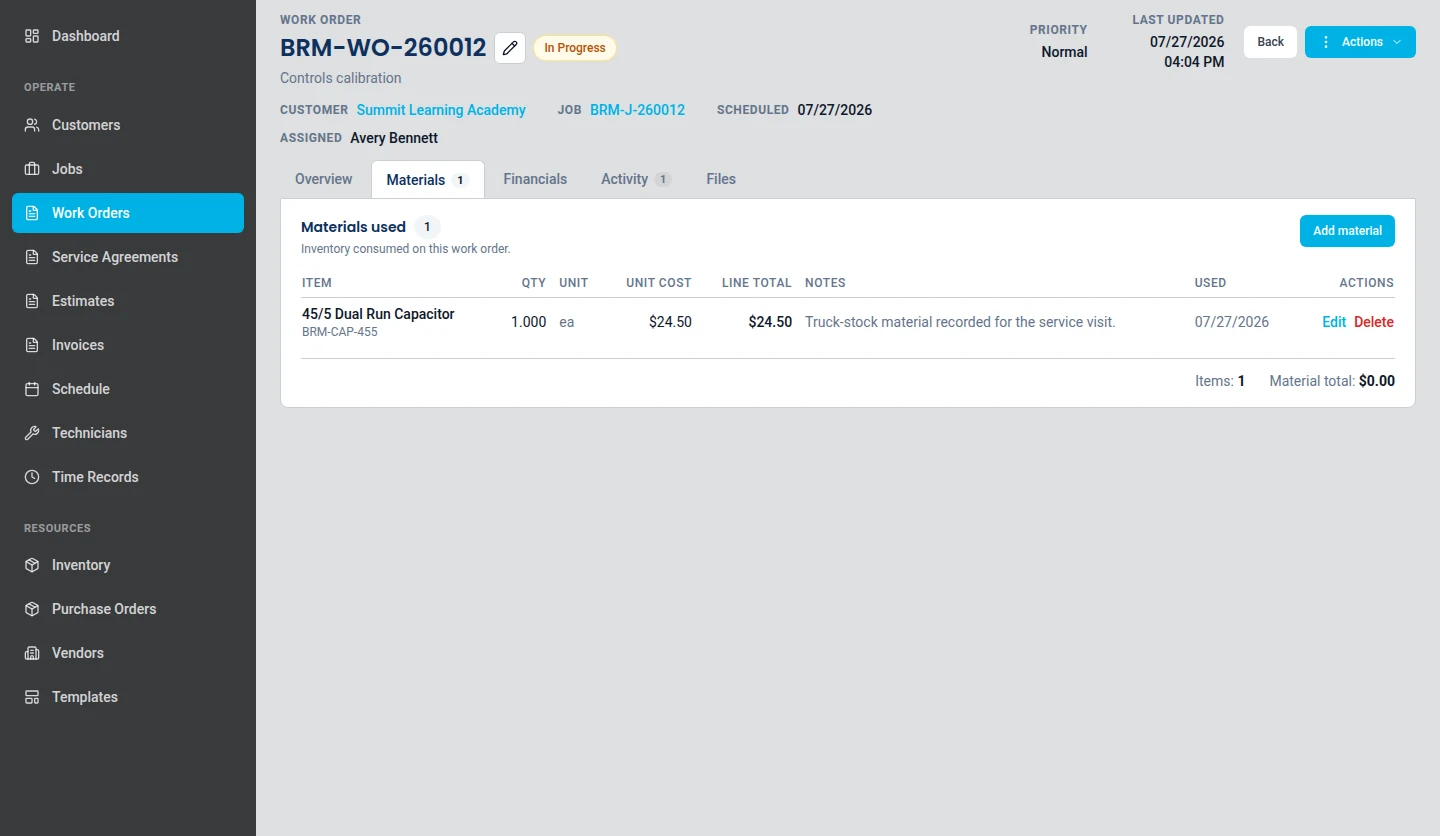
If you already have steady work and the problem is running it, ServusOne is the shape that helps. Work orders carry the parts and materials recorded against the job, time records carry their categories and approval status, installed equipment carries its own service history, and all of it stays attached to the customer it belongs to.
That operational record is also what makes billing honest: the invoice reflects what happened, it goes out while the customer still remembers you were there, and it reaches QuickBooks Online without anyone typing it a second time.
Winning work and running work are different problems, and a business usually has one of them at a time. If yours is the second — jobs that finish without being billed properly, parts that were never logged, a technician arriving without knowing what is installed — then depth on the work is what you are buying, and that is what ServusOne was built to be.
ServusOne is the right call when
Where ServusOne stands out
Depth on the work itself. Parts and materials are recorded against the job as it happens. Hours are clocked against it with their categories and approval status. Neither has to be reconstructed at the end of the week from memory and a photograph.
Equipment and its service record. Installed units on a customer site carry make, model, serial number and their own service history. For a maintenance-led business that record is the asset, and it is the reason the second visit goes faster than the first.
One thread from estimate to payment. An accepted estimate becomes an invoice with its line items intact, and recorded payments stay attached to the job. Nothing is re-entered on the way through.
Your books stay in step. ServusOne connects to QuickBooks Online: customers linked on an exact match rather than guessed at, invoices exported, and payments and refunds reconciled back when you switch them on. The office stops producing a second copy of information you already had.
The customer can serve themselves. Work orders, invoices and accepted estimates are visible to the customer in their own portal, which absorbs most of the “can you resend that” traffic without anybody buying a second product to make it happen.
The part of ServusOne this comes down to
What changes in a week of work
Name your bottleneck first
Acquisition and operations are different problems, and these two products are strongest at different ones. Decide which is actually costing you money this quarter, then pick the product that is strongest there.
Test the repeat visit
Run the same scenario through both trials: a return visit to equipment you serviced six months ago. What does the technician see? That single test separates these products faster than any feature comparison.
Follow the materials to the invoice
Record a part on a job, clock two hours against it, and raise the invoice. Count the places a human has to retype something. That count is the running cost you will pay every week for years.
Price the plan you would actually be on
Both products put capabilities on different tiers. Work out which tier of each covers what you need — including phones in the field — before comparing any headline number.
Count the jobs that never became invoices
Go back through last month and find the visits that were done but not billed, and the parts fitted but not charged. That number is the honest measure of what an operations-first system is worth to you, and it is usually larger than anyone expects.
Where Housecall Pro fits better
Housecall Pro is built around winning and delighting residential customers, and it does that better than ServusOne does. This is the short, factual version, read from its own pricing page on the date shown.
What Housecall Pro publishes
- Housecall Pro publishes three plans — Basic, Essentials and Max.
- Those plans include one, five and eight users respectively.
- Basic already covers online booking, invoices and payments, scheduling and dispatching, quotes and proposals, and review management.
- Essentials adds routes, flat-rate pricing, checklists, photo reports, commissions, a QuickBooks sync and GPS tracking — and ServusOne offers no GPS tracking at any tier.
- Max adds a sales proposal tool, recurring service plans, API access, dedicated onboarding and route optimization, which ServusOne does not perform.
- It offers a 14-day free trial with no credit card required.
Choose Housecall Pro when
- Customers booking you online is part of how you grow — ServusOne does not offer online booking.
- Collecting and displaying reviews matters to your marketing — ServusOne has no review capability.
- You need documented API access to build on top of the system.
What ServusOne does not do
- No online booking and no review management. Housecall Pro publishes both on its entry plan. ServusOne offers neither, and if either is central to how you grow, that is decisive.
- No GPS tracking and no automatic route optimization. ServusOne offers no GPS tracking, no technician location and no telematics, and it does not perform automatic route optimization.
- No published API. Customer-managed API tokens and webhooks are not yet offered, so there is no public API to build on today.
- Mobile workforce access is an Enterprise capability. It is included on the Enterprise plan and is not in the Starter or Professional public catalog.
Housecall Pro statements above were read from its own published material on 2026-08-29, not from a third-party review or comparison site:
See it for yourself
Stock, purchase orders, and the parts each job consumed.
Time and attendanceClock in against jobs, review the week, export payroll.
Equipment and service historyMake, model, serial, and every visit against the unit.
Field service software buying guideHow to evaluate a field service system without being sold to — including this one.
Estimate-to-invoice workflow guideWhere money leaks between the accepted estimate and the paid invoice — and how to close it.
Put your own week of work through it
The trial runs for fourteen days without a card, and every plan price, included seat count and per-additional-user rate is published.